
Gut Health
Leaky Gut Syndrome Treatment: A Practical Protocol Guide for Practitioners
Leaky gut syndrome — also called increased intestinal permeability — is increasingly recognized as a contributor to systemic inflammation, autoimmune...
Leaky Gut Syndrome Treatment: A Practical Protocol Guide for Practitioners
Leaky gut syndrome — also called increased intestinal permeability — is increasingly recognized as a contributor to systemic inflammation, autoimmune conditions, and food sensitivities. This guide walks through a clinically proven four-phase treatment approach that you can implement immediately in your practice.
What is the most effective treatment approach for leaky gut syndrome?
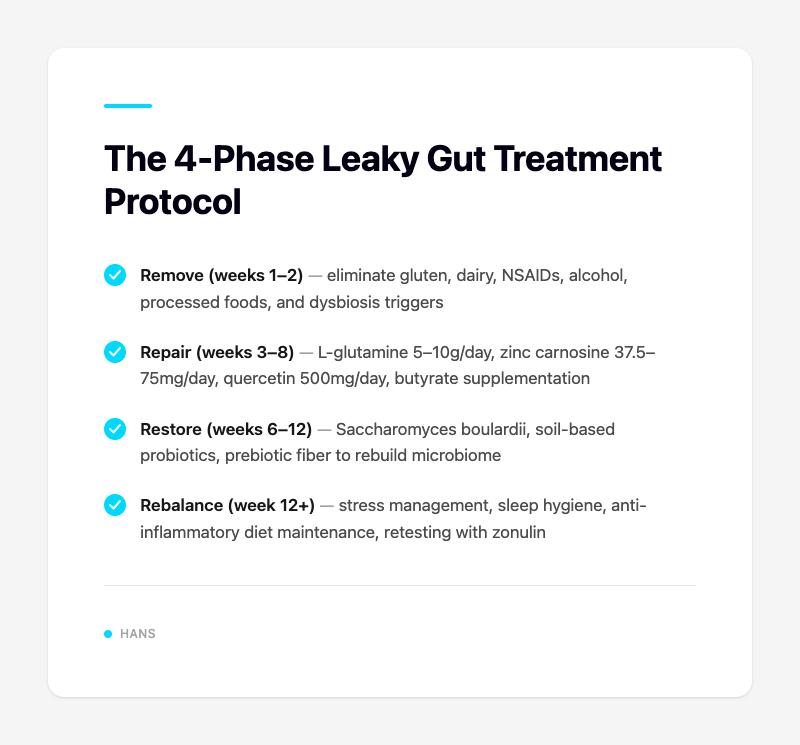
The most effective approach follows a four-phase protocol: Remove → Repair → Restore → Rebalance. This systematic framework addresses the root causes while actively rebuilding intestinal barrier function.
The four phases:
- Remove — Eliminate triggers that damage tight junctions (gluten, NSAIDs, alcohol, dysbiosis)
- Repair — Provide nutrients that directly support mucosal healing and tight junction integrity
- Restore — Rebalance the microbiome with targeted probiotics and prebiotics
- Rebalance — Address lifestyle factors (stress, sleep, anti-inflammatory diet) to maintain long-term barrier function
Most patients require 8-12 weeks minimum for measurable improvement. Rushing the protocol or skipping phases leads to relapse.
Which supplements are most evidence-based for tight junction repair?
Four supplements have the strongest evidence for directly repairing intestinal barrier function:
L-Glutamine (5-10g/day)
The most studied amino acid for gut barrier integrity. Glutamine serves as the primary fuel for enterocytes and has been shown to improve claudin-1 expression, reducing intestinal permeability.
Clinical pearl: Divide doses (e.g., 5g twice daily) for better tolerance. Patients with significant mucosal damage may need the higher end of this range.
Zinc Carnosine (37.5-75mg/day)
This chelated form of zinc has unique mucosal protective properties. Research shows it stabilizes small bowel integrity and stimulates gut repair processes — particularly valuable for patients with NSAID-induced permeability.
Clinical pearl: Zinc carnosine is distinct from zinc picolinate or gluconate. The carnosine moiety provides gut-specific benefits that other zinc forms don't offer.
Butyrate/SCFA
Short-chain fatty acids, particularly butyrate, are the primary energy source for colonocytes and strengthen tight junctions through epigenetic modulation. Consider tributyrin or butyrate supplements for patients with colonic involvement.
Quercetin (500mg daily)
This flavonoid stabilizes mast cells and inhibits zonulin release, addressing the immunological component of permeability. Particularly useful in patients with concurrent mast cell activation or significant food sensitivities.
What does an elimination diet protocol look like for leaky gut patients?
A structured elimination diet is essential during the Remove phase. Here's how to implement it clinically:
Duration: 2-4 weeks strict elimination
Foods to eliminate:
- Gluten (all wheat, barley, rye, and derivatives)
- Dairy (milk, cheese, yogurt, whey)
- Soy and soy products
- Corn
- Eggs
- Tree nuts and peanuts
- All processed foods and refined sugars
Reintroduction protocol: After the elimination period, systematically reintroduce one food category every 3-4 days, monitoring for symptom recurrence. This identifies individual triggers while expanding the diet to the widest tolerable range.
Clinical pearl: Many patients feel worse before they feel better (die-off reactions, histamine release). Set expectations early — the first week is often the hardest.
What lifestyle factors most significantly impact leaky gut healing?
Three lifestyle factors consistently emerge as barrier-breaking contributors:
Stress Management
Chronic stress elevates cortisol, which directly damages tight junction proteins. Incorporate stress-reduction strategies into every protocol:
- Breathwork or meditation (even 5-10 minutes daily)
- Adaptogenic herbs (ashwagandha, rhodiola) when appropriate
- Exercise stress management (avoid overtraining)
Sleep Quality
Poor sleep increases intestinal permeability and systemic inflammation. Target 7-9 hours of quality sleep. Sleep hygiene protocols should be part of every comprehensive leaky gut plan.
NSAID Avoidance
Non-steroidal anti-inflammatory drugs are among the most damaging substances for intestinal tight junctions. This is often the hardest sell with patients — educate them on alternatives (acetaminophen, turmeric, professional-grade CBD) for pain management.
Alcohol Reduction
Alcohol directly disrupts tight junction integrity and increases endotoxin absorption. Complete avoidance during the active healing phase, with moderation (if any) thereafter.
How long does leaky gut healing take, and how do we monitor progress?
Realistic timeline:
- Weeks 1-2: Remove phase — symptom exacerbation possible
- Weeks 3-8: Active repair phase — most patients see improvement
- Weeks 6-12: Restoration of microbiome
- Week 12+: Rebalance and maintenance
Monitoring options:
- Zonulin testing (stool) — gold standard for permeability
- Lactulose:mannitol ratio — classic permeability test
- Symptom tracking — bloating, energy, brain fog, joint pain
- Food sensitivity retesting — typically at 8-12 weeks
Remind patients: "Weeks 4-6 are when the magic happens. Don't stop early."
Case Example: 38-Year-Old Female with Post-NSAID Leaky Gut
Presenting symptoms: Bloating, fatigue, joint pain, brain fog — symptoms began after 6 months of daily NSAID use for migraine management.
Testing:
- Stool zonulin: Elevated (78 ng/g, reference < 50)
- IgG food sensitivity panel: 14 reactive foods (dairy, gluten, eggs prominent)
Protocol implemented:
| Phase | Weeks | Interventions |
|---|---|---|
| Remove | 1-2 | Eliminated gluten, dairy, eggs; discontinued NSAIDs |
| Repair | 3-8 | L-glutamine 5g BID; zinc carnosine 37.5mg BID; quercetin 500mg daily |
| Restore | 6-12 | Saccharomyces boulardii; soil-based probiotic; prebiotic fiber |
| Rebalance | Ongoing | Stress management; sleep hygiene; anti-inflammatory diet |
Outcome at 10 weeks:
- Zonulin normalized (42 ng/g)
- Food sensitivities reduced from 14 to 3
- Bloating and brain fog completely resolved
- Energy significantly improved
Key takeaway: This case illustrates that addressing the trigger (NSAIDs) is equally important — if not more important — than the supplements.
Visual Resources
Cross-section showing tight junctions between enterocytes, with zonulin pathway, passing from lumen to bloodstream. Label: healthy vs leaky state.
Timeline showing Remove → Repair → Restore → Rebalance over 8-12 weeks with supplements and dietary interventions for each phase.
Zoomed-in diagram showing claudins, occludins, and zonulin.
[GRAPH: Leaky gut contributing factors] Infographic showing: gluten, NSAIDs, alcohol, antibiotics, stress, dysbiosis.
Key Takeaways for Clinical Practice
- Four-phase approach — Remove, Repair, Restore, Rebalance is a memorable, actionable framework
- Supplements with evidence — L-glutamine, zinc carnosine, butyrate, and quercetin form the core
- 8-12 weeks minimum — Set realistic expectations; healing takes time
- Eliminate triggers first — Supplements won't work if the patient keeps taking NSAIDs
- Test and retest — Use zonulin or lactulose:mannitol to objectively track progress
Related Resources
- → Pillar: Leaky Gut Treatment Guide — Comprehensive pathophysiology and deeper dive into tight junction biology
- → Hub: FM Protocols — Functional medicine protocol library
- → See HANS Pricing — Automate your FM documentation workflow
Documenting leaky gut protocols takes time. See how HANS automates FM documentation →
References
- PMID: 27749689 — "Glutamine and the regulation of intestinal permeability: from bench to bedside" (2016)
- PMID: 16777920 — "Zinc carnosine, a health food supplement that stabilises small bowel integrity and stimulates gut repair processes" (2006)
- PMID: 38612477 — "Leaky Gut and the Ingredients That Help Treat It: A Review" (PMC9862683, 2023)
- PMID: 39047703 — "The Leaky Gut and Human Diseases: Pathophysiology, Measurement and Therapeutic Strategies" (2024)
- PMID: 31076401 — "Leaky gut: mechanisms, measurement and clinical implications in humans" (2019)