
Hormonal Health
Adrenal Fatigue Protocol: A Functional Medicine Approach
Q: What is adrenal fatigue and how does it differ from HPA axis dysfunction?
Adrenal Fatigue Protocol: A Functional Medicine Approach
Q: What is adrenal fatigue and how does it differ from HPA axis dysfunction?
Adrenal fatigue is a popular term patients often come in with, but as practitioners, we know it's more accurate to call this HPA axis dysregulation. The adrenal glands aren't "fatigued" in the classical sense—they're caught in a dysfunctional feedback loop. The hypothalamus-pituitary-adrenal axis loses its circadian rhythm, and cortisol output becomes either chronically elevated, flatlined, or chaotic.
The terminology matters because it shifts our approach from "supporting tired adrenals" to restoring HPA axis function. That's the real goal.
Q: What do cortisol rhythm patterns tell us about treatment?
When we test—whether via DUTCH urine or salivary cortisol rhythm—we typically see four main patterns:
| Pattern | Morning | Afternoon | Evening | Clinical Significance |
|---|---|---|---|---|
| Elevated | High | Normal/high | Fails to drop | Chronic stress, hypercortisolism, anxiety |
| Flat | Normal | Drops too steeply | Very low | Exhaustion, "burned out" |
| Frozen | Low across all times | Low | Low | Severe dysregulation, often post-crisis |
| Chaotic | Unpredictable | Erratic | Erratic | Advanced dysregulation, irregular lifestyle |
Treatment adapts to the pattern—this is why testing matters. You wouldn't treat an elevated cortisol pattern the same way you treat a flat pattern.
Q: What's the functional medicine protocol framework?
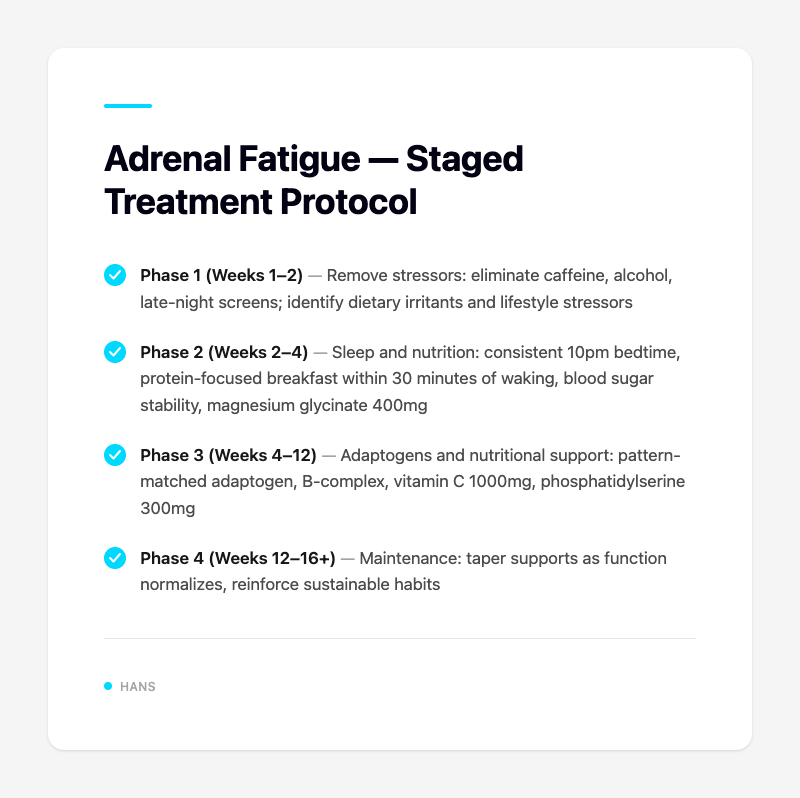
We use a phased approach—this isn't a supplement protocol, it's a lifestyle reconstruction:
Phase 1: Remove Stressors (Weeks 1-2)
- Eliminate caffeine, alcohol, late-night screen time
- Identify and address dietary irritants
- Assess lifestyle stressors (work, relationships, overtraining)
Phase 2: Sleep & Nutrition (Weeks 2-4)
- Consistent bedtime (ideally 10pm)
- Protein-focused breakfast within 30 minutes of waking
- Blood sugar stability throughout the day
- Magnesium glycinate 400mg at bedtime
Phase 3: Adaptogens & Nutritional Support (Weeks 4-12)
- Adaptogen selection based on cortisol pattern
- B-complex, vitamin C 1000mg, phosphatidylserine 300mg
- Continue sleep optimization
Phase 4: Maintenance (Weeks 12-16+)
- Taper supports as function normalizes
- Reinforce sustainable habits
<<<<<<< HEAD
=======
65abf4f0 (vault backup: 2026-03-03 23:01:14)
Q: How do I choose adaptogens based on cortisol pattern?
| Cortisol Pattern | First-Line Adaptogen | Dose | Timing | Contraindications |
|---|---|---|---|---|
| Elevated | Ashwagandha (KSM-66) | 300-600mg daily | Morning or split AM/PM | Hashimoto's (may blunt thyroid), sedating |
| Flat/Fatigue | Rhodiola rosea | 200-400mg | Morning on empty stomach | Bipolar, SSRIs, bleeding disorders |
| General stress | Holy basil (tulsi) | 500-1000mg | Split AM/Noon | Anticoagulants, pregnancy |
| Frozen/Severe | Consider adrenal glandulars or consult | — | — | — |
Ashwagandha has solid evidence—PMID 37832082 (Majeed et al., 2023) showed cortisol reduction and improved stress/anxiety scores in an RCT. PMID 27055824 (Choudhary et al., 2017) demonstrated effects on cortisol and body weight under chronic stress.
Q: What testing do you recommend?
Two main options:
- DUTCH cortisol rhythm (four points)—provides metabolite panel, gives you free cortisol and cortisone, useful for comprehensive hormone mapping
- Salivary cortisol rhythm (four points: wake, noon, 4pm, 10pm)—simpler, cheaper, PMID 30216577 (Van Dam et al., 2018) validates the cortisol awakening response as a reliable HPA axis measure
Either way, four points across the day is essential. A single cortisol level tells you almost nothing.
Q: Can you walk me through a case example?
Patient: 42F, executive
- Fatigue worst upon waking and at 2-4pm
- Difficulty falling asleep (racing mind at 11pm)
- Cravings for salt and sugar
- Brain fog, reduced concentration
- Weight gain despite minimal appetite
- "Burned out" after 18 months of high-stress work
Testing (DUTCH cortisol rhythm):
- Elevated morning cortisol (29 mcg/dL at wake)
- Flat slope through afternoon
- Inappropriately elevated evening cortisol (8.2 mcg/dL at 10pm)
Protocol:
- Remove: caffeine, alcohol, late-night screen time
- Sleep: consistent 10pm bedtime, magnesium glycinate 400mg
- Nutrition: protein-focused breakfast within 30 min of waking, blood sugar stability
- Adaptogens: Ashwagandha KSM-66 600mg daily (elevated pattern)
- Nutrients: B-complex, vitamin C 1000mg, phosphatidylserine 300mg
- Exercise: morning walks, yoga, no evening HIIT
Results (8 weeks):
- Morning energy improved 60%
- Sleep onset faster, better quality
- Evening cortisol normalized
- Brain fog resolved
- Patient reported "feeling like myself again"
Note: Full recovery took 4 months. Adrenal healing is a marathon, not a sprint. Set expectations early.
Key Takeaways for Practice
- Test, don't guess — cortisol rhythm patterns dictate treatment
- Remove before add — stressors first, then supports
- Match adaptogens to pattern — ashwagandha for elevated, rhodiola for flat
- Timeline: 3-6 months — patients need realistic expectations
- Lifestyle is the protocol — supplements support, they don't replace
→ Pillar: Adrenal Fatigue & HPA Axis Protocol Guide
→ Hub: FM Protocols
→ Get started: /pricing
Ready to stop documenting and start treating?
HANS automates your cortisol rhythm documentation, generates pattern-matched protocol notes, and keeps your adaptogen rationale audit-ready — so you spend your time with patients, not paperwork.